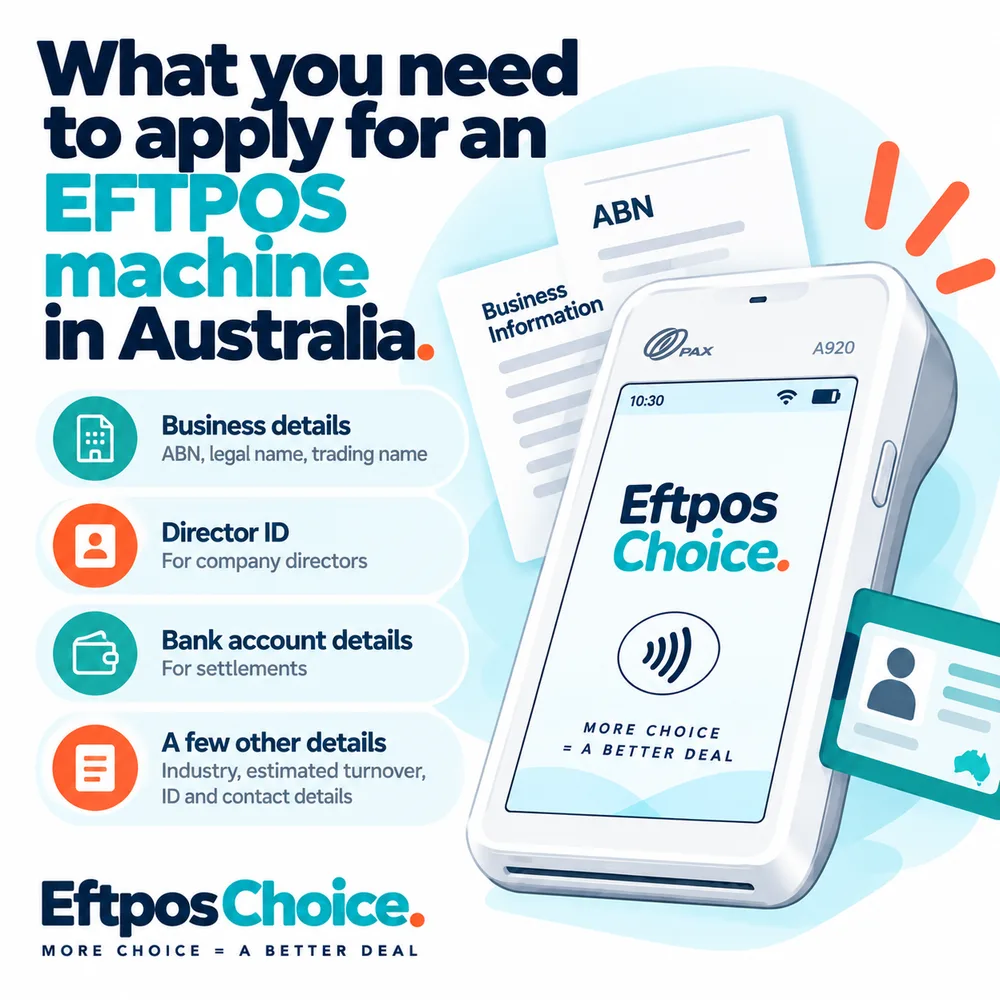
What you need to apply for an EFTPOS machine in Australia
ABN, photo ID, a bank account in the business name, and an honest turnover figure. Most delays are a missing document.
Short answer: an ABN, photo ID for whoever owns or controls the business, a business bank account in the business name, and a straight answer on what you sell and how much of it. That’s the core of it. Everything else an acquirer asks for is either because of who you are (a company, a trust, a charity) or because of what you do (anything they think might blow up on them).
Most applications that drag on don’t drag on because the merchant got knocked back. They drag on because one document was missing and nobody chased it for four days. So here is the list, and here is why they want each thing.
The four things every acquirer will ask for
1. Your ABN. Active, and matching the trading name you want on the receipt. If the ABN is cancelled or the name on it doesn’t match what you’ve written on the form, the application stops dead at the first check. Look yourself up on ABN Lookup before you start — it takes thirty seconds and saves a week.
2. Identification. Driver licence or passport for the owners and directors. If it’s a company, they want it for anyone holding 25% or more, and for any director. If it’s a trust, they want the trustee. This isn’t the bank being nosy — it’s Anti-Money Laundering law, and there is no version of this where you talk your way out of it.
3. A bank account in the business name. This is the one that trips people up most. The settlement account has to be in the name of the entity that holds the merchant facility. If the ABN is in the company’s name and the bank account is in your personal name, that is a mismatch and it will be rejected. Not “queried” — rejected. A bank statement header or an internet banking screenshot showing the account name, BSB and account number is usually enough.
4. What you sell, and roughly how much. Your monthly card turnover, your average transaction value, and what the product or service actually is. You’ll also be asked what proportion is face-to-face versus over the phone or online.
Don’t lowball the turnover figure to look modest. The acquirer sets your processing limits off the number you give them, and if you say $20,000 a month and then do $90,000 in your first month, the risk team will hold your settlement while they ask what happened. I’ve seen it. It’s a horrible way to spend a week.
What gets asked for on top, and why
If you’re a company or a trust: the certificate of registration, and for a trust, the trust deed. They’re establishing who legally controls the money.
If you’re brand new: no trading history means no evidence, so expect to be asked for something else that stands in for it — a lease, supplier invoices, a business plan, or a personal guarantee from a director.
If you take payment before you deliver: this is the big one, and it has nothing to do with your credit. If a customer pays you in March for a job in September, the acquirer is carrying the risk that you don’t do the job. Gyms, travel, event ticketing, furniture on order, building work, anything with a deposit — all of it is watched more closely, and it is where a rolling reserve gets put on a facility. Be upfront about it. Getting found out later is far worse than declaring it on day one.
If you’re in a high-risk category: you’ll know if you are. There are sectors where the answer from a major bank is simply no, and the honest thing a broker does is tell you that on the first call rather than lodge an application that was never going to fly.
What they are actually deciding
Two things, and only two.
The first is identity: are you who you say you are, and is this a real business. That is a compliance question with a yes or no answer.
The second is credit risk, and it is worth understanding properly because most merchants don’t. When you take a card payment, the acquirer pays you before the money is truly final. The cardholder has months to dispute that transaction. If they win the dispute and you’ve spent the money and gone, the acquirer eats it. So an acquirer is a lender, whether or not it ever calls itself one — and everything on that list above is them working out how much exposure they’re carrying and for how long.
Once you see it that way, the questions stop feeling like an interrogation and start looking like the obvious ones.
How to make it go fast
Have it all in one folder before you start. ABN printout, ID both sides, bank statement header, last three months of turnover if you have it, and the lease or website if you’re new.
Put your real numbers down. Round figures, but real.
Nominate one person to answer the phone. The most common cause of a two-week application is the risk analyst emailing a question on Tuesday and nobody opening the inbox until the following Monday.
And pick your provider before you fill anything in, not after. Applying to three acquirers at once so you can “compare” doesn’t work the way it does with home loans — you’ll get three sets of paperwork, three risk reviews, and you’ll still be comparing a blended rate against an interchange-plus rate against a quote with the terminal rental buried in it. Sort out what you’re buying first. Our comparison of what an EFTPOS facility actually costs walks through the pricing shapes, and settlement options covers the part of the application people skip and then complain about later.
The bit nobody tells you
You are allowed to ask questions back.
Ask what the settlement time is, and specifically what happens on a Friday transaction. Ask whether least cost routing is switched on, and whether it’s on by default or something you have to request. Ask what the terminal costs per day and then multiply it out by 365, because $4.40 a day sounds like nothing and it’s over $1,600 a year. Ask whether there’s a lock-in term and what it costs to leave.
An acquirer runs a full credit and identity check on you before they’ll take you on. Spending twenty minutes checking them back is not unreasonable. It’s just even.
If you’d rather not do that part yourself, that’s what we’re for — tell us what you sell and we’ll do the asking.